Natural Wood Veneers: The New Frontier of Sensory Engineering and Material
Authenticity
In the current era of experiential design, natural wood veneers have emerged
as critical tools for sensory engineering—a discipline focused
on shaping emotional and cognitive responses through material behavior. While veneers
have always carried aesthetic weight, the latest design philosophy positions
them as dynamic components in multisensory environments where texture,
geometry, acoustics, and tactile resonance are calibrated with almost
scientific precision.
A fascinating development is the rise of micro-textural modulation,
where veneers are not left as flat surfaces but undergo controlled sculpting,
laser etching, or shallow relief carving to manipulate light scatter and touch
perception. These micro-geometries can soften the acoustic reflectivity of
dense hardwoods or amplify shadow play in minimalist interiors. In high-end
spaces—executive suites, boutique hotels, curated galleries—these subtle
interventions allow veneers to act as ambient filters, altering how occupants
perceive depth, warmth, and movement in a room. 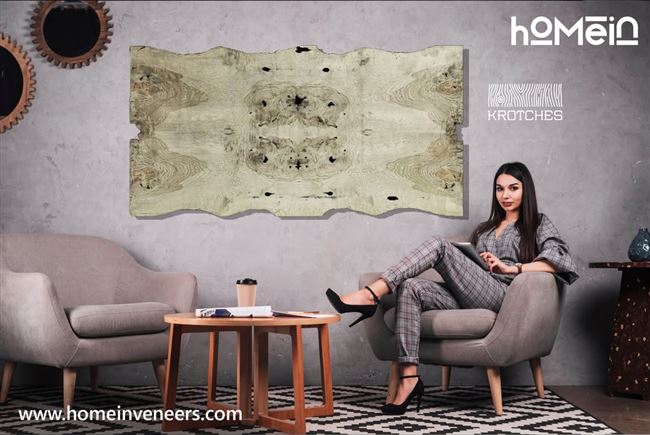
Another emerging trajectory lies in hybrid sensorial layering,
where veneers interface with concealed systems to create multi-functional
surfaces. For example, veneers integrated over vibration-transmitting
substrates can function as invisible speakers, maintaining material purity
while delivering sound. In wellness environments, veneers backed with thermally
conductive panels are used to create warm-touch surfaces—an intentional
contrast to the cool neutrality of metal or stone. The veneer becomes an
interface of emotional comfort, engineered to be as psychologically influential
as it is visually compelling.
Supply-chain innovation has also reshaped expectations. Designers
increasingly request sequence-documented flitch sets, allowing
them to track panel lineage from the initial cut to the final installation.
This provides unmatched control over visual continuity, especially in expansive
projects such as boutique retail rollouts or luxury residential towers. What’s
driving this demand is not mere consistency but a desire to craft spatial
rhythm—every panel a chapter in a narrative of grain progression, figure shift,
and tonal evolution.
Meanwhile, veneer finishing has entered a new phase defined by chemically
intelligent coatings. These ultra-thin finishes adapt to environmental
conditions, resisting UV degradation while maintaining the fiber’s natural
translucency. Some advanced coatings even incorporate micro-crosslinking
technology that tightens molecular structure under heat, significantly
improving scratch resistance without adding gloss or artificial smoothness.
This quiet evolution ensures that veneers can withstand the rigor of commercial
use while preserving the honesty of raw wood.
But perhaps the most transformative shift is conceptual: veneers are now
seen as material translators, bridging the raw
unpredictability of forests with the controlled precision of architecture.
Their thinness, once perceived as a limitation, has become an asset—inviting designers
to use them as expressive membranes over engineered substrates that elevate
performance beyond what solid timber can provide. In many projects, the veneer
becomes a point of philosophical balance, a reminder that natural imperfection
can coexist with industrial exactitude.
In the end, the future of natural wood veneers lies in their dual identity:
sensorially rich, yet technologically sophisticated; biologically unique, yet
engineered for precision. As architecture increasingly emphasizes emotional
impact and material authenticity, veneers stand positioned not as decorative
afterthoughts, but as strategic elements of spatial intelligence.
For More Related Contents Visit Our
Website:
Website: https://homeinveneers.com Follow Us
On: Whatsapp, Facebook, Instagram, YouTube, LinkedIn, Pinterest
|











.jpg)